STEM education is a way of learning that combines Science, Technology, Engineering, and Mathematics through hands-on activities, problem-solving, and real-life situations. For children, STEM is not just about learning formulas—it helps them become curious, creative, and confident problem-solvers.
STEM stands for:
| Letter | Subject | Simple Example for Kids |
|---|---|---|
| S | Science | Learning why ice melts |
| T | Technology | Using a simple coding game |
| E | Engineering | Building a bridge with blocks |
| M | Mathematics | Counting, measuring, or comparing sizes |
STEM learning often combines several of these areas instead of teaching them separately. The goal is to help children ask questions, test ideas, solve problems, and learn from mistakes.
STEM skills are useful far beyond the classroom. Children learn how to think logically, explore different solutions, and apply knowledge to everyday problems.
For example, building a paper tower can teach a child about balance, measurement, materials, and design at the same time.
International data also shows why strong math and science foundations matter. In PISA 2022, 69% of students across OECD countries reached at least basic mathematics proficiency, while 76% reached at least basic science proficiency.
The U.S. National Science Foundation also supports STEM learning in both formal and informal K–12 settings, including hands-on learning and emerging technologies.
STEM does not have to start with complicated robots or computers.
| Age | Suitable STEM Activities |
|---|---|
| 2–4 years | Sorting, stacking, water play, simple puzzles |
| 4–6 years | Building blocks, magnets, simple experiments |
| 6–9 years | Beginner coding, science experiments, simple engineering projects |
| 9+ years | Robotics, programming, design challenges, advanced experiments |
For younger children, play is one of the easiest ways to introduce STEM concepts. Parents can turn ordinary activities such as cooking, building, drawing, or playing with water into simple STEM learning opportunities.
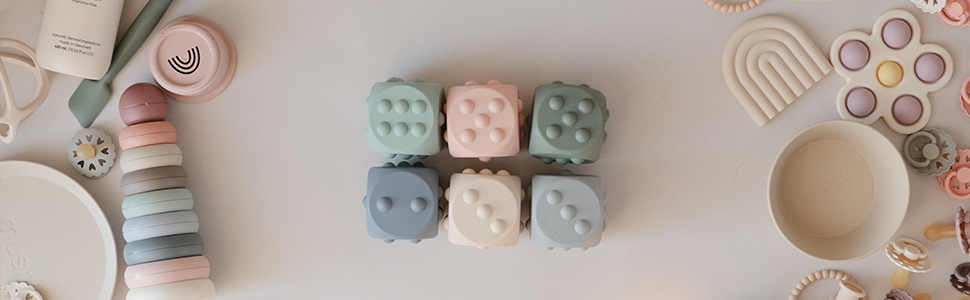
For brands looking to develop their own silicone STEM educational toys, Kangde Silicone provides OEM/ODM services from product design and mold development to mass production. With professional silicone manufacturing experience, Kangde can help customize shape, size, colors, textures, packaging, and functions to meet different age groups and brand requirements.
Silicone is especially suitable for children's educational products because it is soft, durable, easy to clean, and comfortable for little hands. Silicone building toys, stacking toys, sensory toys, sorting games, and other hands-on products can help children explore shapes, colors, numbers, coordination, and problem-solving through play.
From idea to finished product, Kangde Silicone helps brands create customized STEM toys that combine learning, safety, and fun.
| STEM Learning | Traditional Subject Learning |
|---|---|
| Hands-on and interactive | Often focused on instruction |
| Combines multiple subjects | Usually separates subjects |
| Encourages experimentation | Often focuses on correct answers |
| Develops problem-solving | Builds subject-specific knowledge |
| Connected to real-life situations | May be more textbook-based |
This does not mean traditional learning is unnecessary. The strongest approach combines foundational knowledge with opportunities to apply it.
You do not need expensive equipment. Try simple activities such as:
Build: Ask your child to build the tallest tower from blocks.
Explore: Put different objects in water and ask, “Which ones will float?”
Measure: Let your child measure ingredients while baking.
Create: Give children recyclable materials and ask them to design a toy, bridge, or vehicle.
Ask questions: Instead of immediately giving the answer, ask, “What do you think will happen next?”
These activities help children practice the same kinds of reasoning used in STEM learning.
A good STEM toy should do more than entertain. Look for products that encourage children to:
Build and create
Explore cause and effect
Solve problems
Practice counting or measuring
Experiment with different solutions
Use imagination and independent thinking
For younger children, open-ended building toys, sensory activities, puzzles, stacking toys, and simple science kits can be good starting points.
No. STEM concepts can be introduced during early childhood through play, exploration, building, counting, and simple experiments.
No. Coding is only one part of STEM. Science experiments, building, measuring, puzzles, and engineering challenges can all be STEM activities.
Simple hands-on activities are often the easiest starting point. Building blocks, sorting games, water experiments, and measuring activities can introduce STEM concepts naturally.
STEM education helps children develop problem-solving, mathematical reasoning, scientific thinking, and technology-related skills that are increasingly important in education and work.


