
The best way to reduce the cost of a custom silicone product is not simply to ask for a lower unit price. The biggest savings usually come from simplifying the product design, optimizing the mold, choosing the right production process, controlling customization, and ordering a suitable quantity.
For B2B buyers, the goal should be to reduce the total project cost while maintaining the required quality and performance.
A typical custom silicone project may include:
Product design and development
Mold/tooling
Silicone material
Molding and labor
Printing, assembly, or other secondary processes
Packaging
Testing and inspection
Shipping
Published industry examples show that tooling alone can range from hundreds of dollars for simple projects to several thousand dollars or more for complex production molds. The final cost depends heavily on product geometry, mold structure, cavity count, material requirements, and production volume.
| Cost Factor | Higher-Cost Choice | More Cost-Efficient Choice |
|---|---|---|
| Product design | Complex shapes and deep undercuts | Simple, mold-friendly geometry |
| Mold | Too many special features | Optimize cavity and mold structure |
| Material | Over-specified material | Choose the grade that matches the application |
| Decoration | Multiple colors and processes | Limit unnecessary printing/decorations |
| Quantity | Very small production runs | Consolidate demand when practical |
| Packaging | Custom packaging for every unit | Standardized or optimized packaging |
Product geometry has a major effect on tooling cost. Undercuts, complex parting lines, inserts, tight tolerances, and other difficult features can make a mold more complicated and expensive.
Before finalizing the design, ask your manufacturer for a DFM (Design for Manufacturing) review. A small design change made before tooling can be much cheaper than changing the mold later.
A cheaper mold is not always cheaper in the long run.
For lower-volume products, a simple single-cavity mold may be sufficient. For larger annual volumes, multi-cavity tooling can increase the initial investment but reduce the unit cost and improve production efficiency. (定制硅胶产品厂家)
The right question is:
“What mold structure gives me the lowest total cost at my expected volume?”
Manufacturing has fixed costs such as setup, mold installation, material preparation, inspection, and production changeover. When these costs are spread across more units, the unit price generally decreases.
However, ordering far more than you can sell is not necessarily economical. Buyers should balance unit price against inventory, cash flow, storage, and demand.
Custom colors, logos, printing, special textures, individual packaging, and additional assembly can all increase the final price.
For a B2B project, clearly separate essential requirements from nice-to-have features. This can often reduce cost without affecting the product's core function.
Compression molding and LSR injection molding have different tooling and production economics.
For many conventional silicone products, compression molding can be a practical choice. LSR injection molding may be more suitable when the product requires high-volume automated production or more complex precision requirements. The correct process depends on product design, volume, tolerances, and application.
A factory offering the lowest unit price may not offer the lowest overall project cost.
Ask suppliers to quote these items separately:
Tooling + Unit Price + Secondary Processing + Packaging + Testing + Shipping
This makes it easier to compare suppliers fairly and identify hidden costs. Industry purchasing guides also recommend evaluating tooling, production, packaging, testing, and logistics as separate cost components.
There is no universal percentage because every silicone product is different. In many projects, however, the largest opportunities for savings come before mass production starts—especially through design simplification, mold optimization, appropriate material selection, and better production quantities.
A well-designed mold can also reduce long-term unit costs through better production efficiency and higher cavity utilization.
Kangde Silicone is an experienced silicone products manufacturer specializing in OEM and ODM manufacturing for B2B customers. From product design and mold development to silicone molding, post-processing, quality inspection, and packaging, we provide one-stop manufacturing support. Our engineering team can also review product designs and mold structures to help buyers improve production efficiency and control overall costs while maintaining the required quality and performance.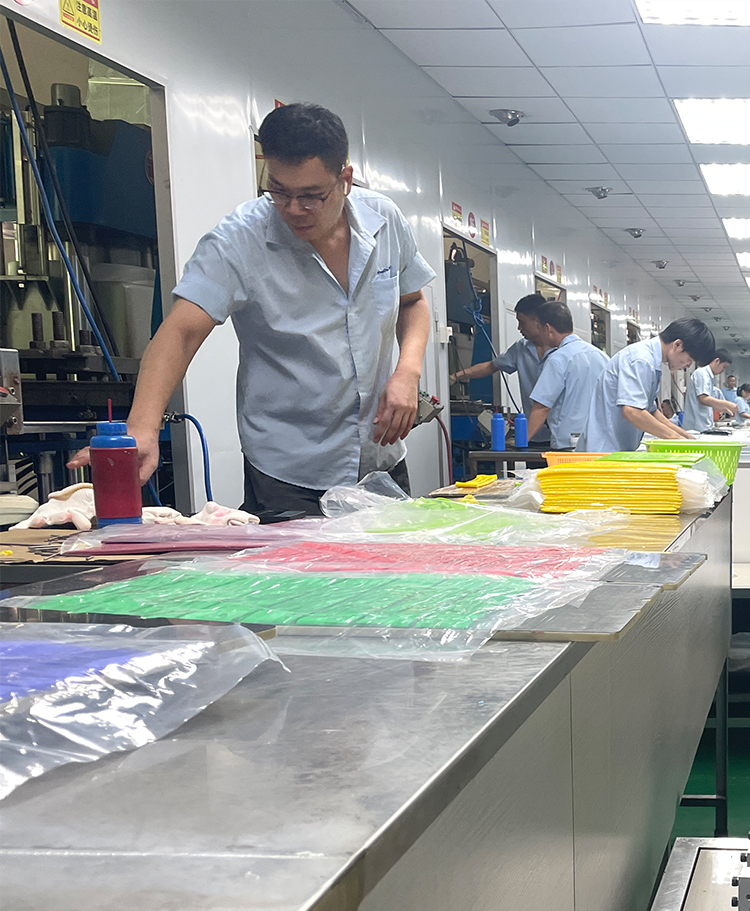
Usually, the most effective approach is to simplify the design, avoid unnecessary customization, choose the appropriate molding process, and order a quantity that matches your actual demand.
Not always. A larger order can reduce the unit cost, but excessive inventory can increase storage and cash-flow costs.
Yes. Mold structure, cavity count, cycle efficiency, and product geometry can all affect production cost.
Not necessarily. Compare tooling, unit price, quality requirements, packaging, testing, lead time, and shipping together to understand the total project cost.


