Different Types of Rubber: From Nature’s Gift to Synthetic Marvels
Rubber – a material prized for its elasticity and resilience – has become indispensable to modern life. From speeding car tires to precision seals, medical gloves to vibration dampeners, it takes countless forms but serves one core purpose: providing essential elastic solutions. However, not all rubbers are created equal. They fall into two main categories, each with unique properties and applications.
I. Nature’s Offering: Natural Rubber (NR)
Source: Harvested primarily as latex from the Hevea brasiliensis rubber tree.
Key Component: Polyisoprene-based polymer chains.
Key Advantages:
- Exceptional Elasticity & Resilience: Unmatched ability to return to its original shape after repeated stretching.
- High Strength & Abrasion Resistance: Strain-induced crystallization provides excellent tear resistance and wear performance.
- Low Heat Buildup: Generates minimal internal heat under dynamic conditions (e.g., tire rolling).
- Good Processability: Easily mixed with additives and formed into products.
Key Limitations: Relatively poor resistance to oils, solvents, and ozone; prone to hardening/crystallization at low temperatures.
Primary Applications: High-performance tire treads, vibration dampeners (e.g., engine mounts), high-elasticity seals, medical gloves, elastic bands. Its superior dynamic performance and elasticity make it the preferred choice for demanding applications.
II. Human Ingenuity: Synthetic Rubber
Chemical synthesis has yielded a vast array of synthetic rubbers, engineered to meet specific needs beyond natural rubber's capabilities. Key types include:
Styrene-Butadiene Rubber (SBR):
Status: World's highest-volume synthetic rubber (copolymer of butadiene & styrene).
Properties: Excellent abrasion resistance, good aging resistance, cost-effective.
Applications: Tires (especially carcasses & sidewalls), conveyor belts, shoe soles, general industrial rubber goods.
Polybutadiene Rubber (BR):
Properties: Outstanding resilience, excellent low-temperature flexibility, high abrasion resistance.
Applications: Tire treads (often blended with NR/SBR), golf ball cores, critical dampers, industrial goods requiring supreme resilience.
Nitrile Rubber (NBR):
Key Advantage: Superior resistance to oils, fuels, and solvents (copolymer of butadiene & acrylonitrile).
Applications: Fuel system seals (O-rings, gaskets), oil-resistant hoses, printing rollers, oil field equipment parts.
Chloroprene Rubber (CR):
Properties: Inherently flame retardant, excellent weather/ozone resistance, good chemical resistance, strong adhesion.
Applications: Cable jackets, adhesives, weatherstripping (doors/windows), fire hoses, protective coatings.
Ethylene Propylene Rubber (EPM/EPDM):
Properties: Exceptional weather/ozone resistance, heat resistance, and chemical resistance; excellent electrical insulation. Includes EPM (ethylene-propylene) and EPDM (ethylene-propylene-diene).
Applications: Automotive weather seals, radiator hoses, roofing membranes, wire/cable insulation, chemical linings.
Butyl Rubber (IIR):
Key Property: Exceptionally low gas permeability; good heat/weather/chemical resistance; excellent damping.
Applications: Tire inner tubes, tire innerliners, pharmaceutical stoppers, damping materials, sealants.
Silicone Rubber (SiR):
Properties: Extreme temperature stability (-60°C to +200°C+), excellent weather resistance, physiological inertness, good electrical insulation, high gas permeability.
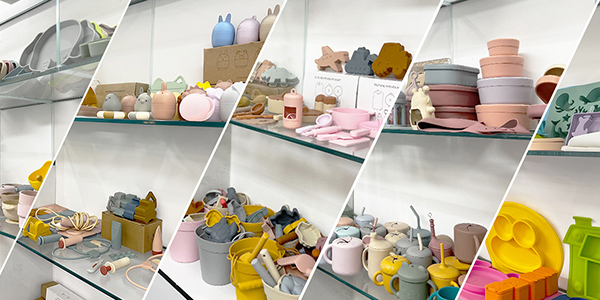
Applications: High-temperature seals, silicone baby toys, baby feeding sets, silicone kitchen supplies, silicone baking molds, silicone chocolate, candles, soap molds, silicone daily necessities, medical implants/devices, insulators, keypads,etc.
Fluoroelastomer (FKM):
Properties: Premium resistance to high temperatures (200°C+), oils, and chemicals among rubbers.
Applications: Aerospace seals, automotive fuel systems/turbocharger components, chemical plant seals, high-performance O-rings.
| Key Property |
Natural Rubber (NR) |
SBR |
NBR |
CR |
EPDM |
Silicone (SiR) |
FKM |
| Elasticity/Resilience |
★★★ |
★★ |
★★ |
★★ |
★★ |
★★★ |
★ |
| Abrasion Resistance |
★★★ |
★★★ |
★★ |
★★ |
★★ |
★ |
★★ |
| Oil/Solvent Resistance |
★ |
★ |
★★★ |
★★ |
★ |
★ |
★★★ |
| Heat Resistance |
★★ |
★★ |
★★ |
★★ |
★★★ |
★★★ |
★★★ |
| Low-Temp Flexibility |
★ |
★ |
★ |
★★ |
★★★ |
★★★ |
★★ |
| Weather/Ozone Resist. |
★ |
★★ |
★★ |
★★★ |
★★★ |
★★★ |
★★★ |
| Gas Permeability |
★★ |
★★ |
★★ |
★★ |
★ |
★★★ |
★★ |
| Typical Cost |
Medium |
Low |
Medium |
Medium-High |
Medium |
High |
Very High |
Selection & The Future
Choosing the right rubber is an art of balancing hardness, strength, elasticity, temperature range, resistance to media (oils/chemicals), weather resistance, cost, and processability. Technological advances continually expand the rubber frontier with specialty synthetics (e.g., Hydrogenated Nitrile Rubber - HNBR, Thermoplastic Elastomers - TPE/TPV) and sustainable options (bio-based synthetics, sustainably farmed natural rubber).


