When an infant is constantly chewing to relieve gum pressure, the safety and hygiene of the material are paramount. Consumer Product Safety Commission (CPSC) and global health standards place rigorous benchmarks on infant oral products. Let’s evaluate how the most common materials stack up against real-world safety data.
Food-grade silicone is widely considered the safest and most functional material by modern pediatricians. Because it is non-porous, it does not harbor microscopic germs or warp under high heat. It offers a unique texture—firm enough to provide distinct counter-pressure on swollen gums, yet flexible enough to protect delicate oral tissues from bruising.
Derived from natural tree sap, pure rubber teethers are eco-friendly, biodegradable, and exceptionally soft. However, they cannot tolerate high-heat sterilization (dishwashers or boiling water will degrade the material) and carry a slight risk of triggering latex allergies in sensitive infants.
Natural hardwoods like beechwood offer excellent, firm resistance for older babies whose teeth are actively breaking through the surface. Hardwood contains natural antimicrobial properties. The downside is maintenance: wood cannot be submerged in water or steamed, requiring diligent wipe-downs with a damp cloth.
Not Recommended. Pediatric dental groups strongly advise against liquid- or gel-filled plastic rings. If a baby punctures the outer plastic layer with emerging sharp teeth, they can ingest the internal liquid. Furthermore, plastic cannot be boiled for sterilization without risking chemical leaching.
| Material | Chemical Safety | Mold & Bacteria Risk | Dishwasher / Sterilizer Safe? | Durability | Best For |
| Food-Grade Silicone | 🏆 Excellent (BPA, PVC, Lead-Free) | Zero Risk (Solid, non-porous piece) | Yes (Highly heat-resistant) | Exceptional (Won't crack or chip) | All teething stages & hassle-free cleaning |
| Natural Rubber | Good (Plant-based, toxic-free) | Low (If designed without holes) | No (Hand-wash only; heat warps it) | Moderate (Degrades over time) | Early teething stages & soft gum relief |
| Beechwood | Good (Natural, untreated) | Low (Natural antimicrobial) | No (Wipe clean only; avoids splitting) | High (Can splinter if damaged) | Firm chewing & older infants |
| Plastic (Liquid-Filled) | Poor (Risk of chemical leaching) | High (If seams split or puncture) | No (Will melt or warp) | Low (Prone to punctures) | Avoid for safety reasons |
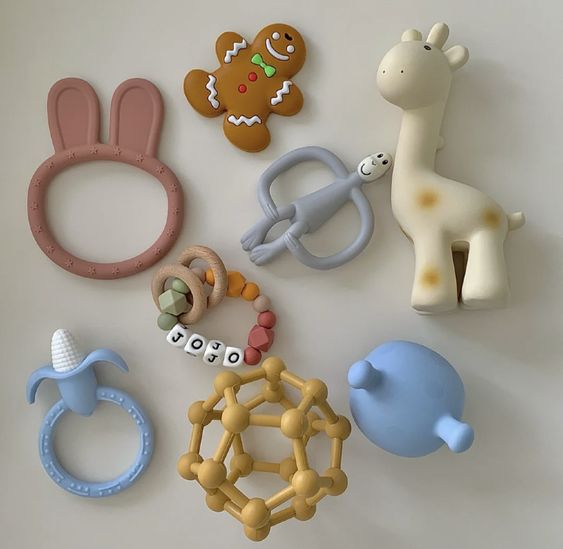
To ensure a teething toy truly solves your baby's discomfort without introducing hidden safety hazards, look for these design elements:
Seamless, No-Hole Construction: Avoid hollow teethers with squeakers or internal cavities. Drool and bathwater easily get trapped inside these cavities, creating a dark, moist breeding ground for toxic black mold that is impossible to clean.
Ergonomic, Anti-Drop Grips: Younger infants (3–6 months) are still developing fine motor skills. Teethers with built-in wrist loops or open-ring geometries help babies hold the toy independently, keeping it off dirty floors.
Molar Reach without Gagging: A well-designed teether features elongated extensions with textured ridges. These safely reach the back gums where molars emerge, utilizing safety guards to prevent the toy from going too far back and triggering a gag reflex.
Pediatrician Safety Tip: For extra cooling relief, place a solid silicone teether in the refrigerator for 15 minutes. Never place teething toys in the freezer. Freezing-cold objects are too rigid and can cause frostbite or bruising to an infant’s delicate gums.
A: While the first tooth typically erupts between 4 to 7 months, babies experience localized gum swelling and increased drooling as early as 3 months. You can introduce lightweight, easy-to-grip silicone teethers early on to help them soothe early gum pressure and practice hand-eye coordination.
A: For daily maintenance, a quick rinse with mild dish soap and warm water is perfectly fine. Because food-grade silicone is highly heat-resistant, you should deeply sanitize it once a week by placing it on the top rack of the dishwasher or boiling it in water for 2–3 minutes.
A: Multi-piece teething toys often rely on glue, plastic joints, or small connecting parts. Over time, heavy biting can cause these joints to crack or break apart, creating severe choking hazards. A single, molded piece of silicone eliminates this structural risk entirely.


